Most capital is already digital. Very little of it is digitally native.
That difference matters.
A bank balance may appear on a screen, but it still depends on institutional records, permissions, operating hours and reconciliation. A security may trade electronically while ownership, clearing and settlement remain spread across separate systems. A payment may look immediate even though the obligations behind it move more slowly.
Digitisation changes the format. Digital nativeness changes how the system works.
The thesis: Capital is becoming digitally native. Software can increasingly represent who owns an asset, who may act on it and how it can move. This can make markets faster, more open and more programmable. It also moves responsibility into code, devices, data and systems that may fail in unfamiliar ways. Every advance—from Bitcoin and programmable contracts to continuous markets and autonomous systems—solves one problem and reveals the next. The systems that endure will make their dependencies visible, limit authority and preserve legitimate ownership when something goes wrong. Selkara articulates this emerging architecture. CatsQuant develops execution intelligence within it, at the execution layer.
The question is no longer whether more capital will be represented digitally. That is already happening. The question is what kind of architecture will determine who owns it, who may act on it, how it moves and what happens when something fails.

The change is architectural
Public discussion tends to focus on products: Bitcoin, stablecoins, tokenised securities, decentralised finance and artificial intelligence. Each matters. None explains the whole transition.
The deeper change lies in how these developments connect.
Assets are becoming readable by machines. Transactions can follow rules written into software. Settlement is moving closer to execution. Markets are becoming continuously accessible. Through APIs, software can interact directly with venues and financial infrastructure. Machines already act on capital, and they will be given wider economic authority.
That creates real possibilities. It also allows errors and attacks to propagate at network speed.
Digital capital therefore needs more than faster transactions. It needs clear answers to basic questions: What is owned? Who may act? When is a transfer final? Which dependencies sit between the owner and the asset? What happens when one of them fails?
Tokenising an asset does not answer those questions. A token may make a claim easier to transfer without proving that the underlying right is valid. A network may record a transaction without protecting the person behind it. A protocol may remove one intermediary while creating new dependence on software, devices, data or governance that the owner cannot easily inspect.
Technology provides new mechanisms. Architecture determines whether they produce durable rights and usable markets.
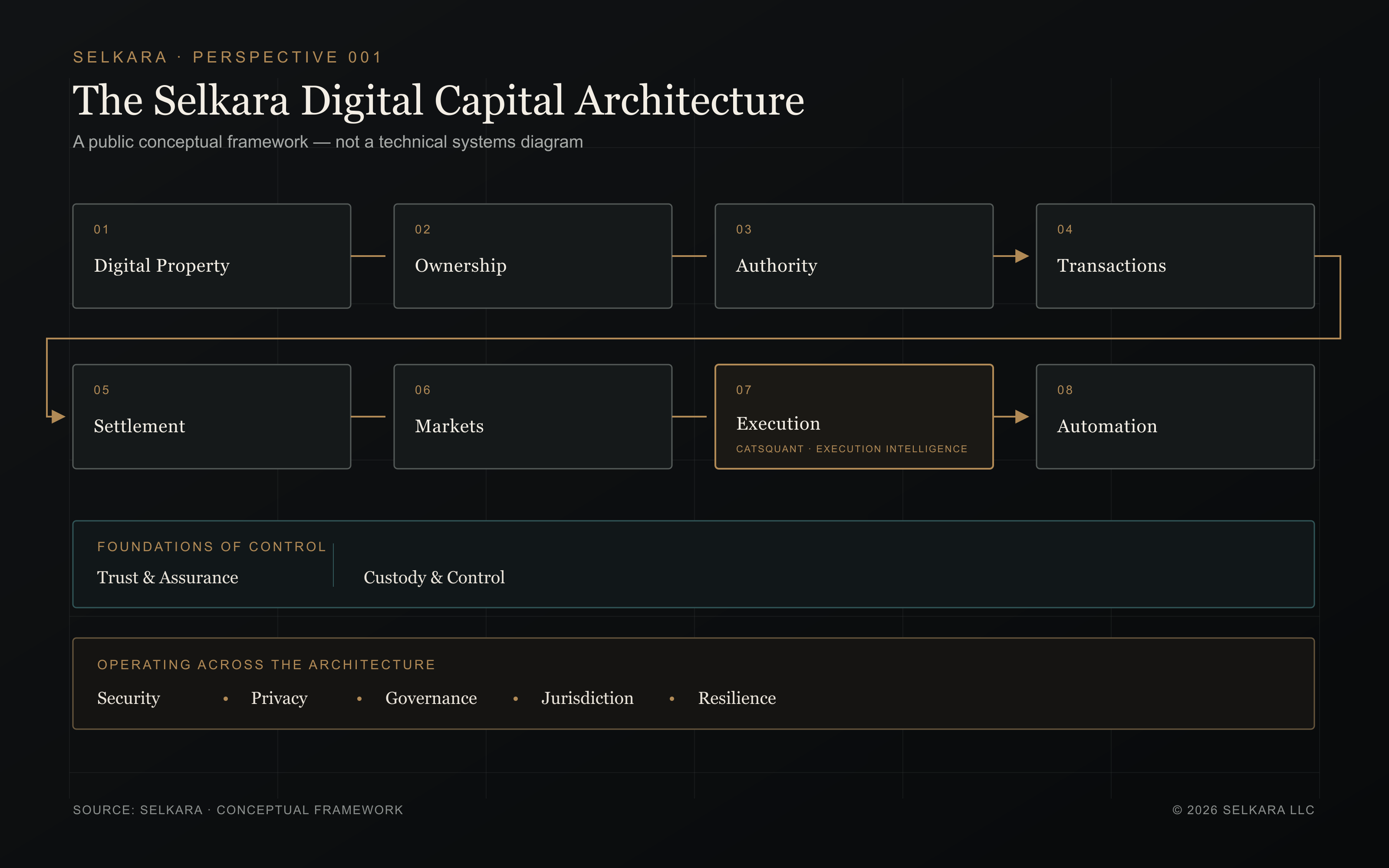
This Perspective introduces the map. Later Perspectives will examine its individual layers.
What Bitcoin changed
The questions behind digital capital did not begin with Bitcoin.
Earlier work on digital currency, secure communications, privacy, pseudonymous identity and bearer instruments had already raised difficult questions about trust, ownership, settlement and human agency.
Bitcoin changed what could be built from that inquiry. It showed that participants could agree on the history and transfer of a digitally scarce bearer asset without a central ownership registry or financial institution preventing double spending.[1]
Ethereum made more complex economic rules programmable. Stablecoins connected network-based settlement to familiar units of account. Decentralised exchanges showed that market formation, liquidity and execution could themselves operate through protocols.
Each development solved one set of problems and revealed another.
Bitcoin addressed digital scarcity and double spending. It did not establish whether every use of a private key reflects the will of a legitimate owner. Programmable networks enabled more complex transactions, but code can fail and authority can be unclear. Decentralised markets reduced dependence on conventional venue operators while introducing new risks around protocols, liquidity, data and governance.
The progress is real. The architecture remains incomplete.
Ownership comes before everything else
Digital systems are good at recording what happened. They are less able to determine whether it should have happened.
A valid signature proves that valid credentials were used. It does not prove that the person or machine using them was the rightful owner, stayed within its authority, understood the transaction or was free from compromise.
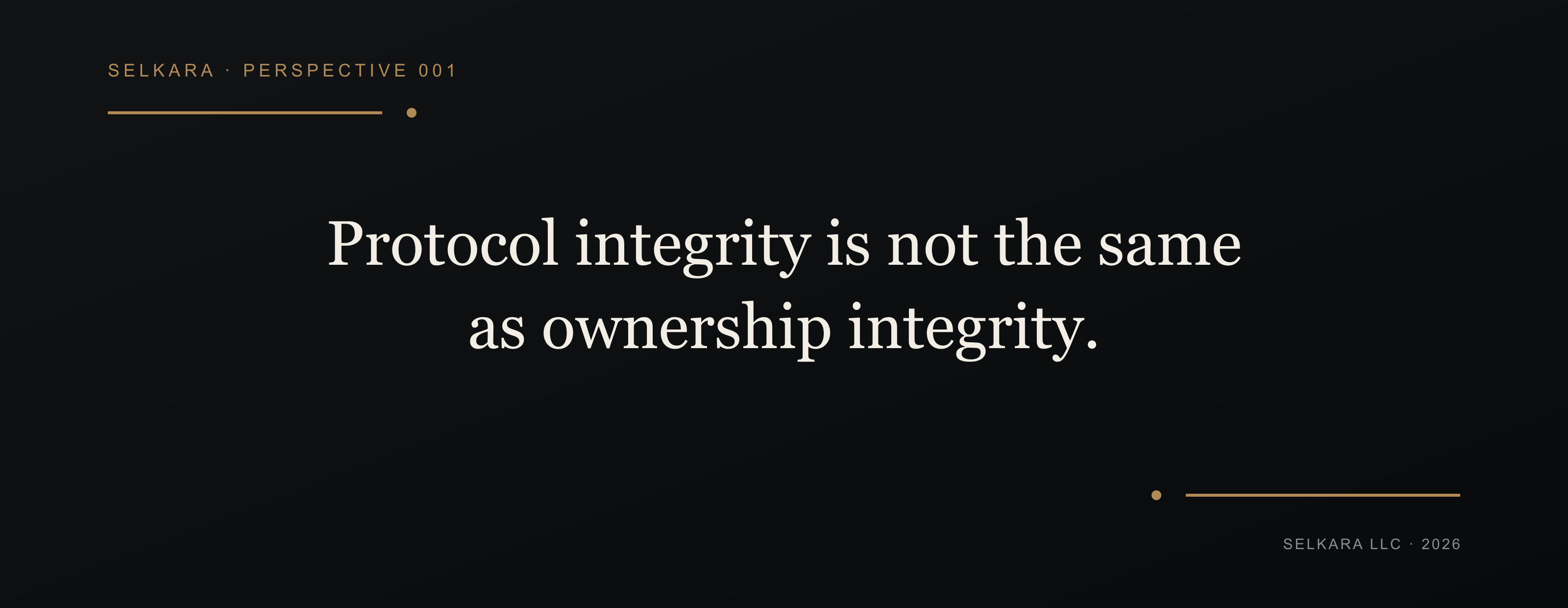
Protocol integrity is not the same as ownership integrity.
A protocol may work exactly as designed while ownership fails at the edge of the system. A device may be compromised. Software may show one transaction while signing another. An authorised person may exceed a mandate. An owner may die without leaving a workable path for succession.
Possession, control and legal title are not always the same. For an asset native to a network, control of the relevant credentials may be the practical condition of possession. For a token representing a security, deposit, property interest or contractual claim, the digital record must also connect to rights recognised outside the network.
Ownership must survive time as well as attack. An asset can remain untouched for years without ceasing to exist. Its owner may be preserving it deliberately, unable to act, unknown to observers or dead. In a persistent digital system, inactivity is not absence. Dormancy is not abandonment.
This is why the debate between self-custody and third-party custody is too narrow. The more useful questions are how control was created, how it is divided, which dependencies surround it and how ownership survives failure. Together, these questions move the discussion from custody to assurance.
“Not your keys, not your assets” remains an important warning. It is not a complete ownership architecture.
Markets that do not close
Digital-asset markets established a simple fact: globally accessible capital can trade continuously.
Liquidity shifts between venues and time zones. Information moves without respecting market sessions. Collateral values change while conventional funding channels may be closed. One venue can fail while others remain active. Risk continues to move when the people responsible for it are unavailable.
Traditional infrastructure is also moving toward longer operating hours. The Committee on Payments and Market Infrastructures has examined extended hours and 24/7 operation for major payment systems, while making clear that the change requires substantial operational work.[4]
Markets without closing hours cannot rely entirely on systems designed around opening bells, end-of-day processes and occasional human decisions. They need systems that can observe conditions, apply limits, route transactions and respond to a degraded venue while staying inside a defined mandate.
This is not a promise of perfect uptime. It is a requirement for readiness, visibility and safe ways to reduce or stop activity.
Settlement needs the same discipline. Bringing execution and settlement closer together can reduce exposure and reconciliation. But speed alone is not safety. Immediate settlement may increase liquidity demands and leave less time to detect an error. Moving assets between networks may introduce bridges or operators with different protections. A technically final transaction can still leave the underlying legal claim unresolved.
Digital capital needs appropriate finality, not speed for its own sake.
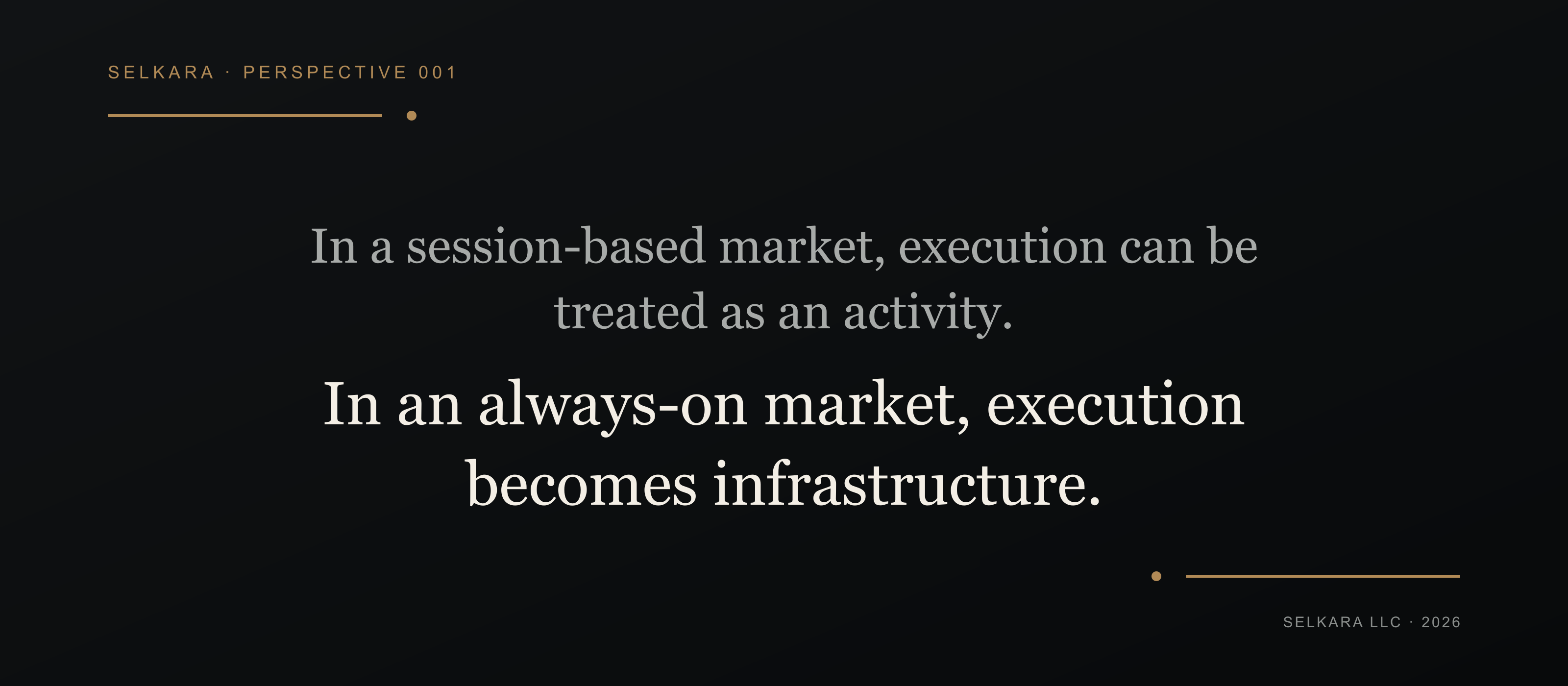
In a session-based market, execution can be treated as an activity. In an always-on market, execution becomes infrastructure.
Execution quality is more than whether an order was filled. Timing, liquidity, spread, market impact, fees, venue risk and the owner’s mandate all matter.
This is where CatsQuant fits.
CatsQuant, a Selkara venture, develops execution intelligence for digital capital markets. Its role follows from the structure of the market: continuous, fragmented and directly accessible to software.
The client retains control of capital and the venue relationship. Permissions are limited to the operating mandate. Activity is observable. Execution can be constrained, paused or terminated under the agreed configuration.
CatsQuant is not the whole architecture. It is one operating expression of it at the execution layer.
When authority becomes programmable
Ownership answers who holds the right. Authority determines who may act on it.
A company may own an asset while different people and systems receive limited authority over it. A portfolio manager may decide how capital is allocated without having the right to withdraw it. An execution system may place and cancel orders without being able to transfer assets elsewhere.
Software can make these limits more precise. Permissions can be restricted by asset, venue, transaction type, size, time or risk condition. They can also be monitored and revoked.
But programmable authority creates its own failure modes. Permissions may be broader than users realise. Credentials may remain active after a mandate ends. Automated systems may act on corrupted data. Revocation may fail when it is needed.
If a machine can allocate capital, initiate payments or manage collateral, the questions are direct:
Who gave it authority? What are its limits? What evidence remains? Who is responsible? Who can stop it?
Autonomous capital is not principally an artificial-intelligence problem. It is a problem of identity, authority and governance.
Building the foundations
The first era of digitally native assets proved that scarce value could exist on open networks, that ownership could be exercised through cryptographic control and that markets could operate continuously across borders.
The next era must connect legitimate ownership with limited authority, continuous markets with resilient execution, rapid transactions with credible settlement, and automation with accountability.
No single network or institution is likely to contain the entire future. Public networks, centralised venues, regulated financial infrastructure and specialised platforms will continue to coexist. The challenge is to connect them without making ownership, authority and risk impossible to understand. Work by the BIS, the Eurosystem and the Financial Stability Board reflects both the potential of programmable financial infrastructure and the risks created by fragmentation and operational weakness.[2][3][5]
Selkara’s interest is not limited to observing this transition. The architecture helps us identify where new systems and ventures need to be built—and how those opportunities relate to one another.
Selkara articulates the changing architecture of capital. CatsQuant builds within it.
Other layers will require other solutions: stronger roots of trust, better ownership assurance, privacy-preserving authority, interoperable settlement, credible governance and infrastructure able to survive technological and jurisdictional change. Future Selkara Perspectives will examine those questions individually.
Capital is becoming digitally native. The task is not simply to digitise more assets. It is to build the conditions under which digital capital can be owned, governed and operated with integrity.
For Selkara, this is not merely a subject of analysis.
It is the foundation for what we build.
Sources
[1] Satoshi Nakamoto, “Bitcoin: A Peer-to-Peer Electronic Cash System,” 2008.
https://bitcoin.org/en/bitcoin-paper.html
[2] Bank for International Settlements, “Anchoring trust in money: innovation beyond stablecoins,” Annual Economic Report 2026, 23 June 2026.
https://www.bis.org/publ/arpdf/ar2026e3.htm
Bank for International Settlements, “The next-generation monetary and financial system,” Annual Economic Report 2025, 24 June 2025.
https://www.bis.org/publ/arpdf/ar2025e3.htm
[3] European Central Bank, “The Eurosystem’s exploratory work on new technologies for wholesale central bank money settlement,” June 2025.
https://www.ecb.europa.eu/press/pubbydate/2025/html/ecb.exploratoryworknewtechnologies202506.en.html
[4] Committee on Payments and Market Infrastructures, “Extending and aligning payment system operating hours for cross-border payments,” 12 May 2022.
https://www.bis.org/cpmi/publ/d203.htm
Committee on Payments and Market Infrastructures, “Operational and technical considerations for extending and aligning payment system operating hours for cross-border payments,” 17 February 2023.
https://www.bis.org/cpmi/publ/d214.htm
[5] Financial Stability Board, “The Financial Stability Implications of Tokenisation,” 22 October 2024.
https://www.fsb.org/2024/10/the-financial-stability-implications-of-tokenisation/